
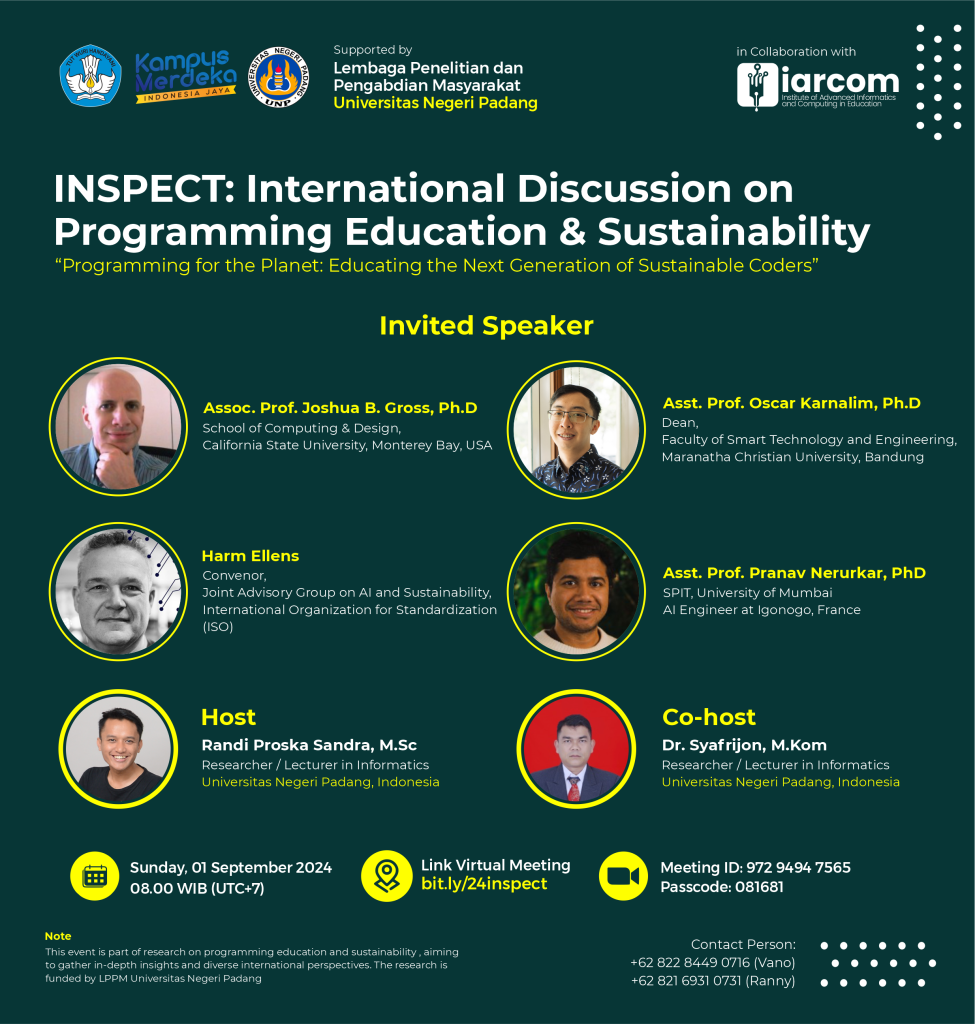
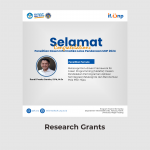
Hosting INSPECT, an International Discussion on Programming Education and Sustainability
Padang, September 1, 2024 – The research team from Universitas Negeri Padang (UNP), comprising Randi Proska Sandra, S.Pd, M.Sc (Chair), Dr. Syafrijon, M.Kom (Member), and Sari Nova, M.Sc (Member), successfully organized an online event titled “INSPECT: International Discussion on Programming Education and Sustainability.” This event was a Focus Group Discussion (FGD) as part of a research series under the Young Lecturer Research Fund scheme, funded by the RKAT of Universitas Negeri Padang.
The event, themed “Programming for the Planet: Educating the Next Generation of Sustainable Coders,” focused on application programming approaches integrated with metacognition and oriented towards a green mindset. One of the key concepts discussed was green programming practices, aimed at identifying strategic principles for producing clean code for young programmers, ensuring that the code requires minimal resources and energy, and results in sustainable software.
The FGD was officially opened by the Rector of Universitas Negeri Padang, Krismadinata, Ph.D.
“I am proud to be here with researchers and experts committed to advancing knowledge in sustainable programming. This FGD is not only relevant to current technological developments but also crucial in the context of global environmental sustainability challenges. I highly appreciate the research team led by Randi Proska Sandra for their initiative in integrating metacognition and a green mindset into programming education. I believe this research is vital for developing programmers capable of applying sustainable software development principles,” stated the Rector in his opening remarks”. stated the Rector in his opening remarks.
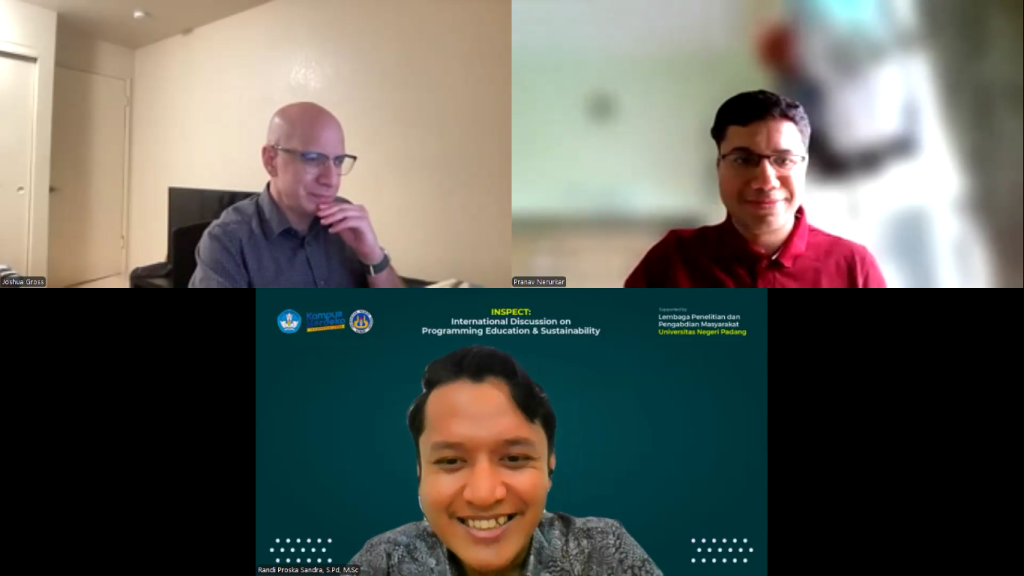
The FGD was divided into two sessions, each featuring two speakers. The first session included Assoc. Prof. Joshua B. Gross (California State University, Monterey Bay, USA) and Asst. Prof. Pranav Nerurkar, Ph.D. (Sardar Patel Institute of Technology (SPIT), University of Mumbai, India). While time complexity and space complexity are commonly discussed in the realm of algorithms and programming, Prof. Gross introduced the new issue of energy complexity, which examines how an algorithm developed by programmers can increase CO2 emissions as the number of users grows. Meanwhile, Prof. Nerurkar focused on Clean Code and the tools needed to detect whether code is clean. Clean code is predicted to use less hardware energy compared to unstructured code. Several tools for detecting clean code were also introduced.
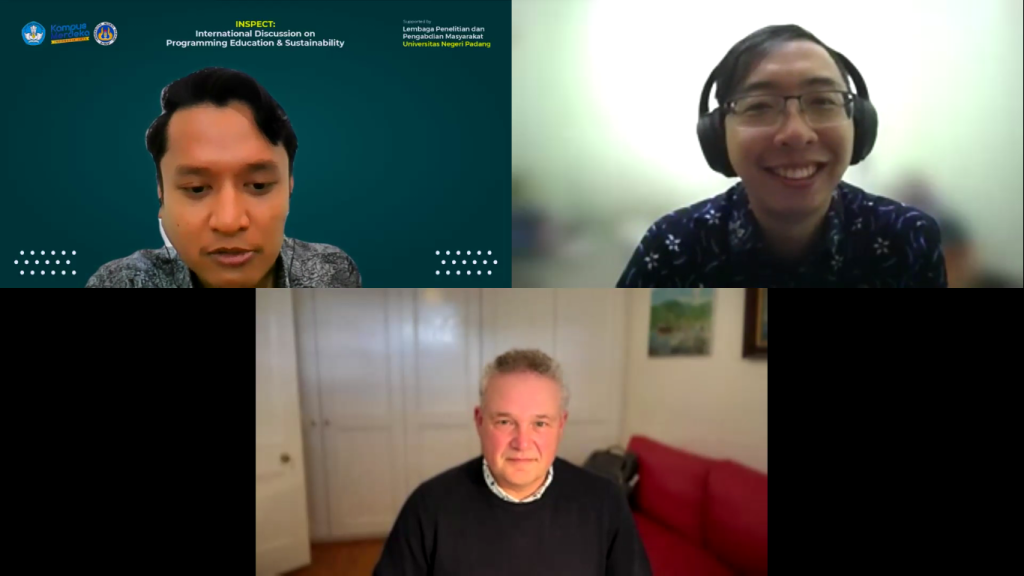
In the second session, the FGD featured Harm Ellens (Convenor, Joint Advisory Group on AI and Sustainability, International Organization for Standardization/ISO) and Asst. Prof. Oscar Karnalim, Ph.D. (Dean of the Faculty of Smart Technology and Engineering, Maranatha Christian University, Bandung). Dr. Oscar explained Code Quality, Code Readability, and Code Smells.
“Many believe that code readability is separate from code quality. However, readability is fundamentally a part of quality,” explained Dr. Oscar in his presentation.
He also discussed code smells, various issues that can occur in programming code, and provided tips for building high-quality code. Meanwhile, Harm Ellens shared his perspective as a practitioner in ISO, an organization that publishes various international standards for industries and institutions worldwide. He explained from the perspective of AI and aspects related to environmental sustainability. Harm Ellens also introduced ISO metrics related to the ecosystem and lifecycle of AI systems.
Randi Proska Sandra directly moderated this FGD.
“Our hypothesis in this research is that bad and unstructured code has the potential to produce environmental impacts, as the developed software may generate higher CO2 emissions due to energy processes in hardware and networks. Therefore, it is important to teach beginner programmers the mindset of sustainable software development,” explained Randi while moderating the event.
This research also involved informatics students as student research members, namely Gevano Randhi Pilko and Ranny Erzitha. Additionally, Afifah Zafirah, M.Pd., and Raudhatul Jannah participated as research assistants.
F
The event was also reported on the university website by this link






Leave a Reply
Want to join the discussion?Feel free to contribute!